Impact Report: Rural Artist in Residence Program
Purpose: to provide outreach and programming in rural Central Oregon through the launch of a 6-month Artist in Residence Program – providing accessible music education, strengthening community engagement, and driving economic development in an underserved region.
Counties served: Wasco, Wheeler, Gilliam, Morrow, and Deschutes
Program Timeline: May - October 2026
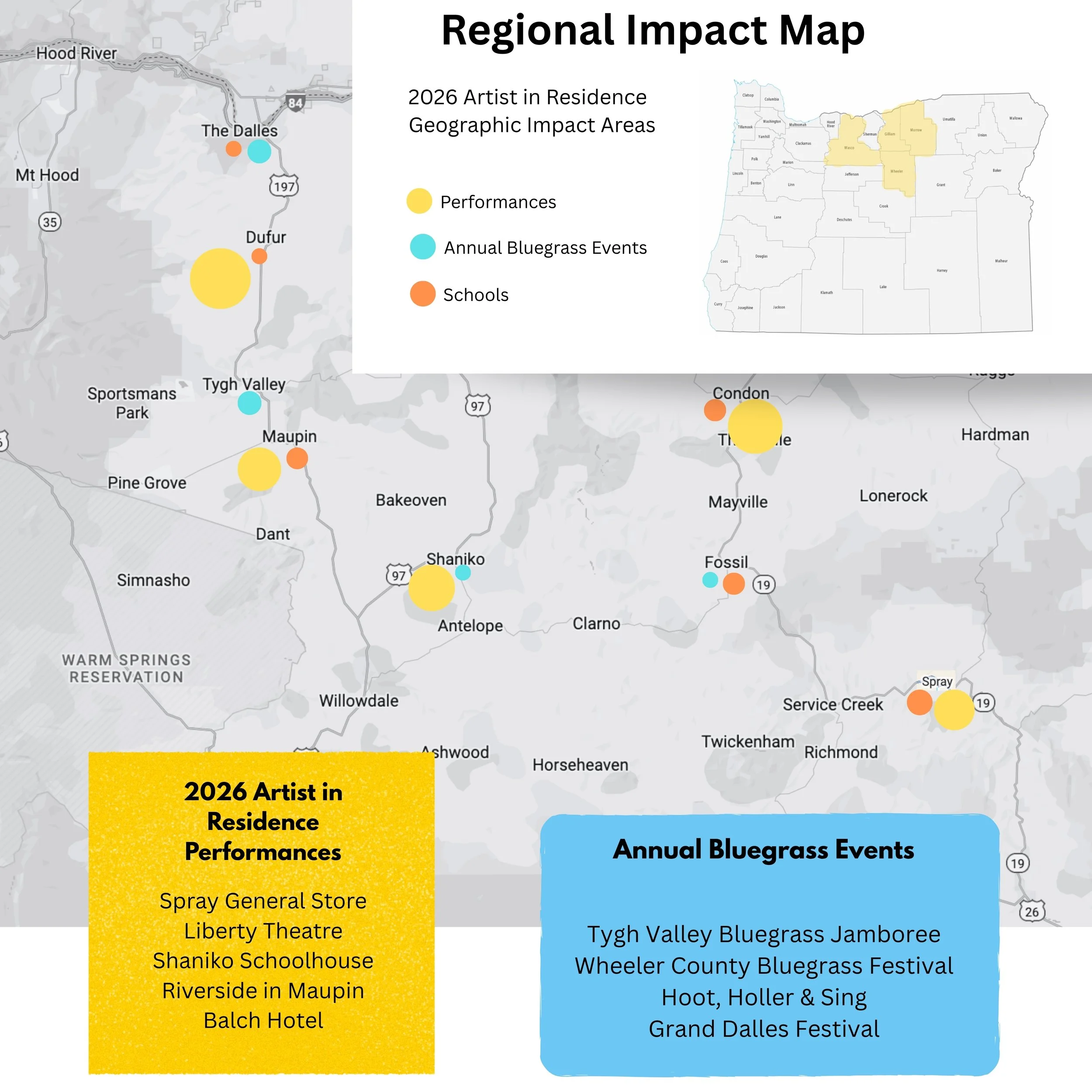
From First Note to Lifelong Music. 2026 Artist in Residence performances and youth classes were intentionally scheduled near schools and annual bluegrass events, so students who take home a new instrument have a nearby community where they can keep playing year after year.
Collaborations with: Maupin Chamber of Commerce, Condon Arts Council, Spray General Store (music venue), Balch Hotel, Riverside (music venue) in Maupin, Frontier Chamber of Commerce. Additional direct program costs covered by Shaniko Music Sanctuary.
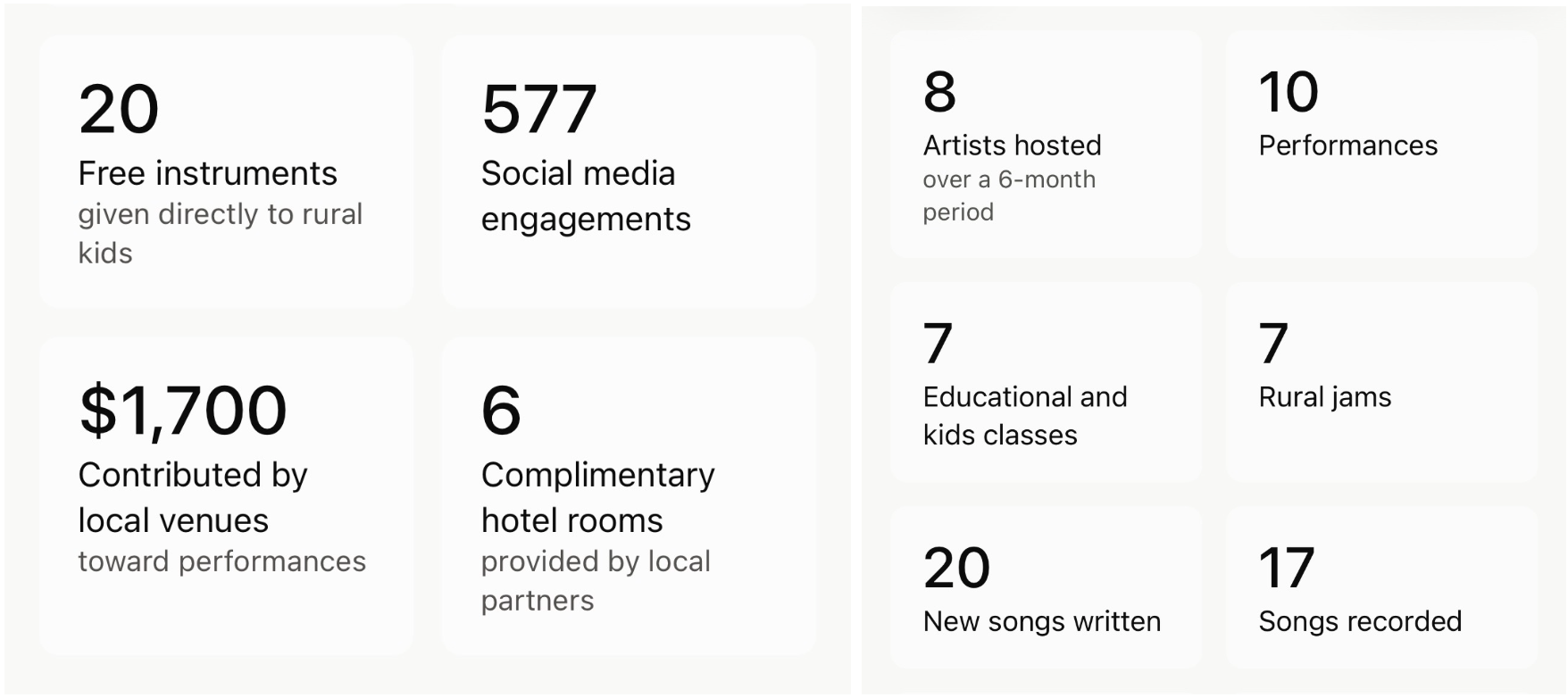
Measuring Program Impact by the Numbers:
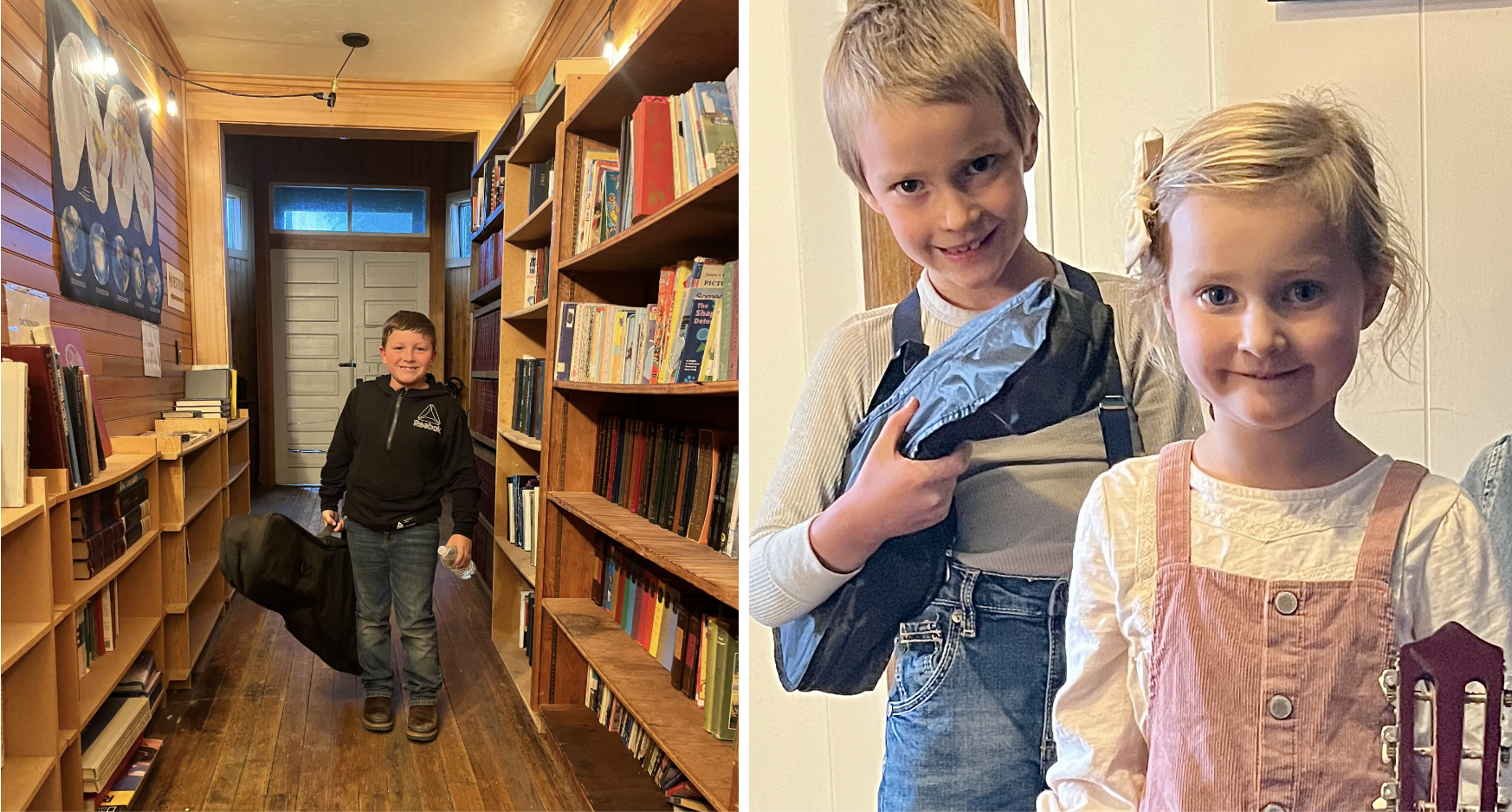
[Left] Emmett (8 years old) from Arlington smiling about the new guitar he was gifted in Shaniko. [Right] Wyatt (6 years old) and Liliana (4 years old) from Condon showing off the mandolin and guitar they got to keep after the Youth Workshop in Eastern Oregon.
Local Perspective
Summary: In addition to bringing free music performances to rural Oregon, the Artist in Residence Program built relationships, encouraged resident participation, and fostered a renewed sense of energy around music in communities where resources are limited.
Shaniko resident shares his sentiment:
“The OBA artists have taken time to get to know our residents. They’ve played music on the porch and shot pool (and sometimes whiskey) in the game room — they’ve really made themselves part of the community in a meaningful way.
It reminds us that rural communities deserve access to the same kind of music and cultural experiences found in larger cities.
Thanks to the Oregon Bluegrass Association for infusing Shaniko with new energy!”
Condon Arts Council Executive Director shares her sentiment below. For context: OBA booked, marketed, and paid for Tuesday String Band to perform and teach a youth workshop at their local theatre – 20 kids attended the workshop and 50 patrons attended the show:
“What a great show! Thanks so much for making this happen for our community – it was absolutely amazing!”
Spray General Store owner shares her sentiment below. For context: OBA booked, marketed and paid for Tuesday String Band to perform as part of the Artist in Residence Program:
“We had a nice intimate crowd and they LOVED IT! Thank You – what a wonderful program!”
Why is this Program Important?
The main home-base for the Artist in Residence Program was Shaniko, Oregon – located in Wasco County, which is ranked as the #1 County in Oregon experiencing Household Financial Hardship.
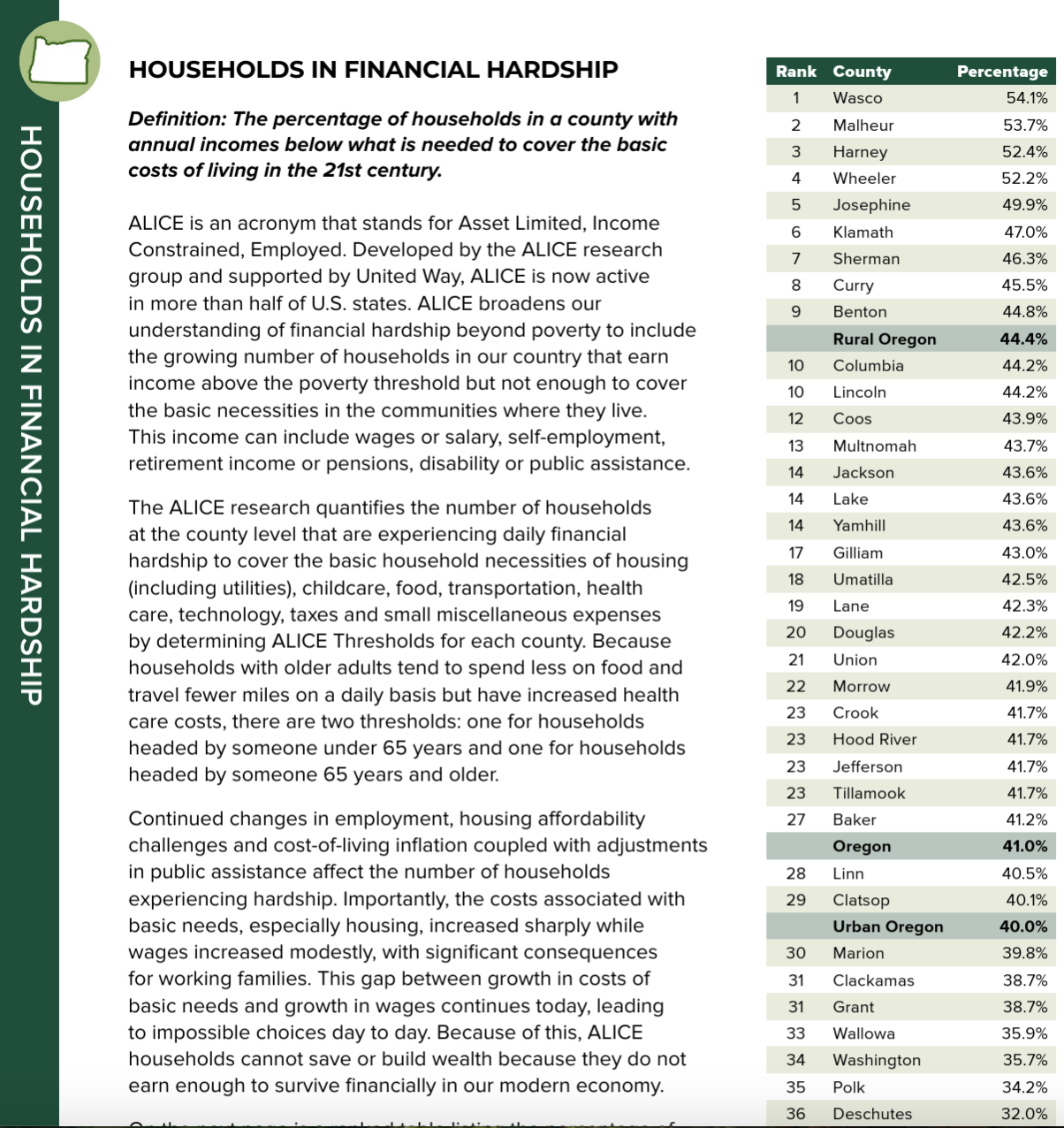
Source: TFFF Oregon By the Numbers
Bringing musicians and music education to an underserved region offered a safe and accessible outlets for behavioral health stresses – an issue exposed as a top resident priority in Insight for Action’s 2023 South Wasco Health Assessment study. Introducing a musician into the community creates an environment for residents and visitors to enjoy the arts together. It nurtures a positive, welcoming atmosphere, and leads to less resident isolation. The Artists in Residence Program was designed to reach veterans, low-income families, and rural communities — leading to healthier mental outcomes.
Participating Artists:
Jimmy Fretwell (Ashland, OR)
Corral Creek Bluegrass Band (Newberg, OR)
Celeste Johnson (Portland, OR)
Belltower (Eugene, OR)
Tuesday String Band (Monmouth, OR)
Gage Carter (Monmouth, OR)
Frank Solivan (National Touring Band)
Use’ta Do (Bend, OR)
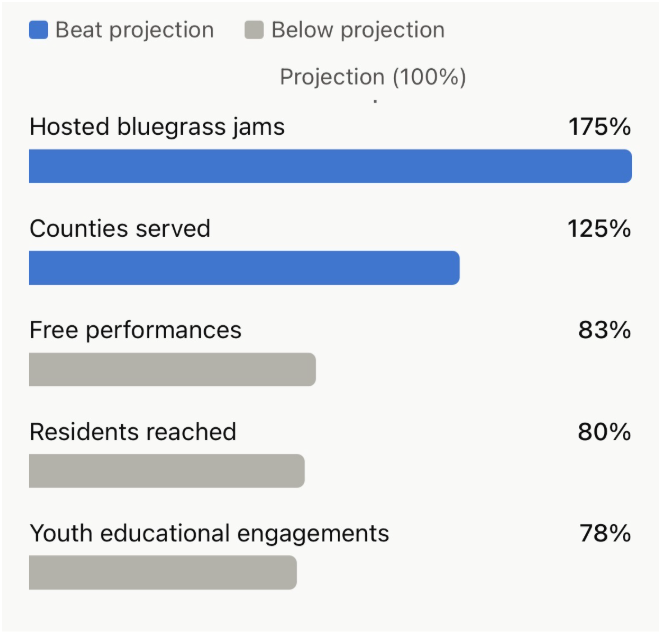
Original Grant Projection (Oct 2025) vs. Actual Results (Oct 2026)
Summary: The program delivered 24 of 25 projected events (jams, free performances, and youth engagements combined) and served one additional county beyond the original proposal. We reached approximately 800 of a projected 1,000 residents. The gap in reach came from audience size at each event, as a result of how sparsely populated and far apart the host communities are.
What we learned:
Jams were our strongest format. We hosted 7 against a projection of 4 (175%), which points to strong local interest in playing music together as well as listening to it.
Audience size limited our reach. Across 24 events we reached 800 residents, about 33 per event against a projected 40.
Small audiences reflect small towns. Performances were held in Condon (population 711), Dufur (632), Spray (139), and Shaniko (30), a combined 1,512 residents in the 2020 Census. The 800 residents we reached is equal to about half of that combined population, and the Condon visit alone drew about 70 people, close to 10% of the town.
Distance limits who can attend. These towns are roughly 50 miles or more apart on two-lane rural highways, an hour or more of driving each way, so each event draws mostly from its own community. Condon to Spray, for example, is 51 miles by road.
Partner-hosted events drew strong turnout. In Condon, where the Arts Council hosted a youth workshop and a show together, 20 kids and 50 patrons attended.
Youth engagements and free performances came in under projection, at 7 of 9 and 10 of 12 — our projection overestimated the capacity of our rural partners. In small towns, these organizations are often run by volunteers, who gave generously but did not always have the time to market and produce events as we had hoped.
Some of our biggest wins were ones we never anticipated. None of these were in our original projection: artists wrote 20 new songs and recorded 17 of them, 20 free instruments went to rural kids, and local partners contributed $1,700 and 6 hotel rooms.
How we will approach next year:
Plan for more jams. Project at least 7, and schedule each one alongside a free performance or youth class so that people who come to play are invited to both.
Set attendance goals as a share of each host town’s population and record attendance by town at every event, so we can report how much of each community we reached and see which towns and formats need more promotion.
We will book dates with schools, arts councils, and venues well in advance of each residency, handle the event logistics, and include a youth class and a free performance in each artist’s residency. This follows the Condon model, where we booked, marketed, and paid for a workshop paired with a show, so that hosting is all we ask of our partners.
We will promote each event earlier and give partners ready-to-share materials, so that volunteers are asked only to pass the word along.
Budget for a project coordinator. We will consider including a coordinator position in next year’s budget to carry the added scheduling, production, and marketing work, so that it does not fall back on volunteers.
Add songwriting, recording, instrument donations, and partner contributions to next year’s projection, with targets based on this year’s results.
Invite venues and lodging partners to commit support before the schedule is set, building on this year’s $1,700 and 6 hotel rooms.
A huge and heartfelt thank you to the Oregon Community Foundation for funding this project, and to all of our Central and Eastern Oregon Partners!
